

The hardest part of investing for systems change isn’t the strategy. It’s bringing others along. And that capacity lives in the steward.
There is something uncomfortable at the heart of systemic investing.
We spend enormous energy analyzing systems out there - the food system, the housing system, the energy system. We study leverage points, map actors, design coalitions. And all of that matters.
But we are always participants in the systems we want to change. We were shaped by them. We benefit from them in ways we don’t always see clearly. And something in us - our fears, our patterns, our defaults under pressure - often helps maintain the very dynamics we say we want to shift.
This is not a reason for paralysis. It is a reason for a particular kind of attention.
Because systemic investing, at its best, is a team sport. No single investor, family, or foundation moves a system alone - or should ever do that. What moves life-giving systems is the quality of collaboration - the ability to stay in relationship across difference, to hold a shared direction without controlling it, to support others without diminishing them, to listen to what is not yet spoken.
And all of that capacity lives in the steward, not just the strategy.
In this piece, I offer two frameworks - Five Ways to Steward and Nested System Sensing - and follow one practitioner’s journey through all five modes. Together, they make the inner work not just visible but actionable.
The inner work isn’t a detour from systems change. It is the soil it grows from.
Five Ways to Steward
When we talk about leadership, we often default to a familiar image: someone as a Leader on Top, directing others because they have the resources, the platform, or the authority. That image has its place - but it is only one mode among many, and it tends to produce compliance at best rather than genuine commitment.
What systemic change ultimately requires is something more alive, more situational, and more relational. We could remember and reconnect with stewardship as practiced in the Indigenous Knowledge Systems of the places we belong to, which have long understood this.
A word on language: I use the word steward rather than leader deliberately. Leadership, in its common usage, can apply broadly - to organisations, movements, teams. Stewardship points toward something more specific: holding something in trust, tending what you did not create alone, remaining accountable to what comes after you. In the context of wealth, it carries an additional dimension - one I explore more fully in my piece What Is Enough?
What Is Enough?

There is a question that wealth tends to generate, sooner or later, in the people who hold it. Not a financial question - those are usually well managed. Something deeper. Something about whether what they are doing with it is right. Whether it is enough. Whether
Wealth is not simply a resource to be deployed. It is a living inheritance, received from the systems and generations that made it possible, held for a time, and passed forward. To steward wealth is to inhabit that relationship consciously - in service of Life, family, and the longer arc. That is a different calling from leadership.
With the intention to create a practical tool, and with the enthusiastic support of Karen Kimsey-House, co-founder of CTI and my personal coach for many years, I have drawn on the Co-Active Leadership framework to evolve the Five Ways to Lead into what I call “Five Ways to Steward” - a map of the situational capacities that wealth holders and investors need as they navigate the complex, relational terrain of systemic change.
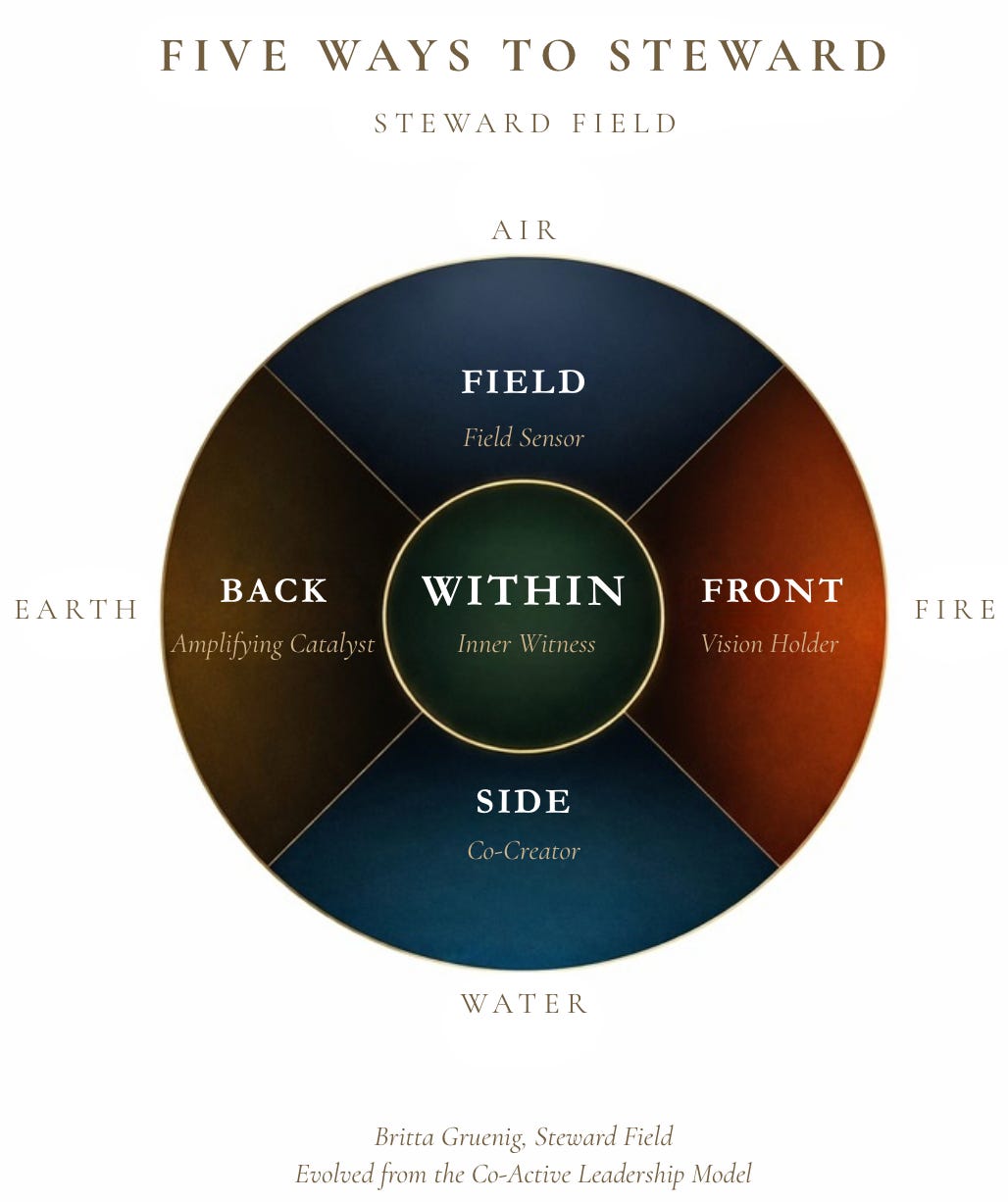
None of these ways is superior. Each is essential. The question is not which one you prefer - it is which one the moment is asking for.
1. Stewarding from the Front: Vision Holder
Holding the Vision and Bringing People Along
This mode is not about being out Front because you have the biggest portfolio or the loudest voice. It is about pointing toward something worth moving toward - and caring as much about the people making the journey as about the destination itself. You articulate a compelling direction, make it legible to others, and create the conditions for people to align around something larger than any one of them.
Vision Holder: The vision is the compass. The people are the work.
Examples: In the context of systems change, this looks like
Jason Jay initiating the Owning Impact Project at MIT, building the research and field-building collaborations that make systemic investing legible to a growing global community of practice.
Dominic Hofstetter, who initiated and built the TransCap Initiative into the primary architecture for the field - creating a space others could build within, contribute to, and carry forward.
Tania Rodriguez Riestra co-founding CO_ in Latin America - a full ecosystem mobilising financial and non-financial capital across incubation, investment, and advisory work at the nexus of climate change and poverty.
Kaj Lofgren gathering a small group of organisations and individuals around a single question - how can we best serve our city? - and from that, Regen Melbourne grew into an alliance of over 200 organisations moving toward a regenerative future.
The people I name here are known figures in the field. The clients I accompany are not named unless they agree to it - I hold their journeys in confidence. But the pattern I see with them is consistent: when I begin working with someone who senses that their capital could serve something larger, this is often the mode they are already in, or reaching toward. They can feel the direction, and they are learning to hold it in a way that others can follow.
Stewarding from the Front is not about having all the answers. It is about holding the direction clearly enough that others can find their place within it - and feeling genuinely moved by seeing them do so.
2. Stewarding from the Side: Co-Creator
Partnering
Not every form of stewardship leads from the front. Sometimes the most powerful thing is to find your people and walk alongside them.
Stewarding from the Side means genuine partnership and co-creation- having each other’s back, co-navigating uncertainty, building shared ownership of both the direction and the work.
Co-Creator: Being willing to co-create and be changed by the relationship, not just to lead through it.
Examples: This is the spirit behind
TWIST
Charly Kleissner and Tharald Nustad co-initiating TWIST - a coalition of investors who together deploy capital toward systems change and evolve the practice as long-standing friends and collaborators.
Alison Fort and Alie Korijn now co-lead TWIST, continuing that same spirit of shared stewardship.
Couples in service of a shared vision who have built entire ecosystems of impact through collaborative ownership of vision
Lisa and Charly Kleissner co-founding Toniic, building it into the leading global network for impact investors committed to moving all their assets toward positive change.
Berry Liberman and Danny Almagor building Small Giants into a living ecosystem of initiatives, educational programs, events, and community anchored in the belief that wisdom and action are inseparable.
Betsy and Jesse Fink helping establish ReFED as a recognised food waste expert with robust data infrastructure.
In my own work, I most often meet this mode with couples who are stewarding a vision together, or with parents who are co-creating the conditions for their children to grow up as conscious stewards themselves. But stewarding from the side is not only a couples dynamic - it can emerge between friends, long-term collaborators, or a generation of cousins finding their shared voice within a family.
Systemic change rarely happens through heroic individual effort. It grows in the space between people who trust each other enough to move together.
3. Stewarding from the Back: Amplifying Catalyst
Supporting and Amplifying
Stewarding from the Back means funding the thought leaders, community organizers, conveners and field builders who are doing this work - the people who know what is needed in the systems you care about, and simply need the right conditions to do it. It means funding and facilitating the orchestration of existing initiatives rather than launching a new one, a finding that TransCap’s research on systemic investing makes compellingly clear.
Amplifying Catalyst: This may be the most undervalued mode in the field - and in some ways, the most catalytic.
Examples:
Funders of TransCap Initiative, TWIST, CSP Global, Dark Matter Labs and other institutions in the space: I won’t name you here, you know who you are.
Dark Matter Labs: Sometimes stewarding from the back means building the invisible infrastructure that makes everything else possible. Dark Matter Labs has made this its entire philosophy: Redesigning the institutional “dark matter” - the governance structures, financing mechanisms, and civic operating systems that most people never see - so that others can build transformative work on more solid ground. It is unglamorous by design. And it may be among the most important work in the field.
CSP Global: It also describes the field building work of institutions like CSP Global, which for over a decade has been building the educational infrastructure through which wealth holders and investors find their way into this territory.
My own work: Amplifying Catalyst describes much of my own work, even though I move fluidly between the modes. For example, Vision Holder from the Front is quite present in my work: Writing and presenting this piece is itself a Front act - offering shared language and frameworks so others can find their place within them. Creating and leading sessions for communities or families is a Front, Side and Field act. At CSP, initiating, birthing, and nurturing the inner-work dimension of wealth-holder education from the ground up is an example from the Front, Side, Back, Field and Within simultaneously. And while all Five Ways to Steward are alive in my work, the ground my service ultimately stands on is very much from the Back as Amplifying Catalyst. Through my stewardship advisory practice, I accompany stewards, couples, and families as they navigate the relational and inner dimensions of their journey - having their backs, facilitating their transformation, celebrating what is emerging, and staying behind their work so their work can go forward.
For many wealth holders, this mode requires a particular kind of inner work. It asks you to find your satisfaction not in visibility or control, but in the vitality of what you are making possible.
4. Stewarding from the Field: Field Sensor
Sensing and Listening
Stewarding from the field begins with a quality of sensing and listening that most of us have not been trained in. Drawing on the Co-Active Levels of Listening framework, we tend to listen at what we might call Level 1: to ourselves - our prior knowledge, our reactions, or we listen to respond to our next point. Or at Level 2: to the content the other person is bringing, with focused, analytical attention. And many of us are aware of the importance of Level 3: noticing the other person’s body language, emotions and what is unsaid.
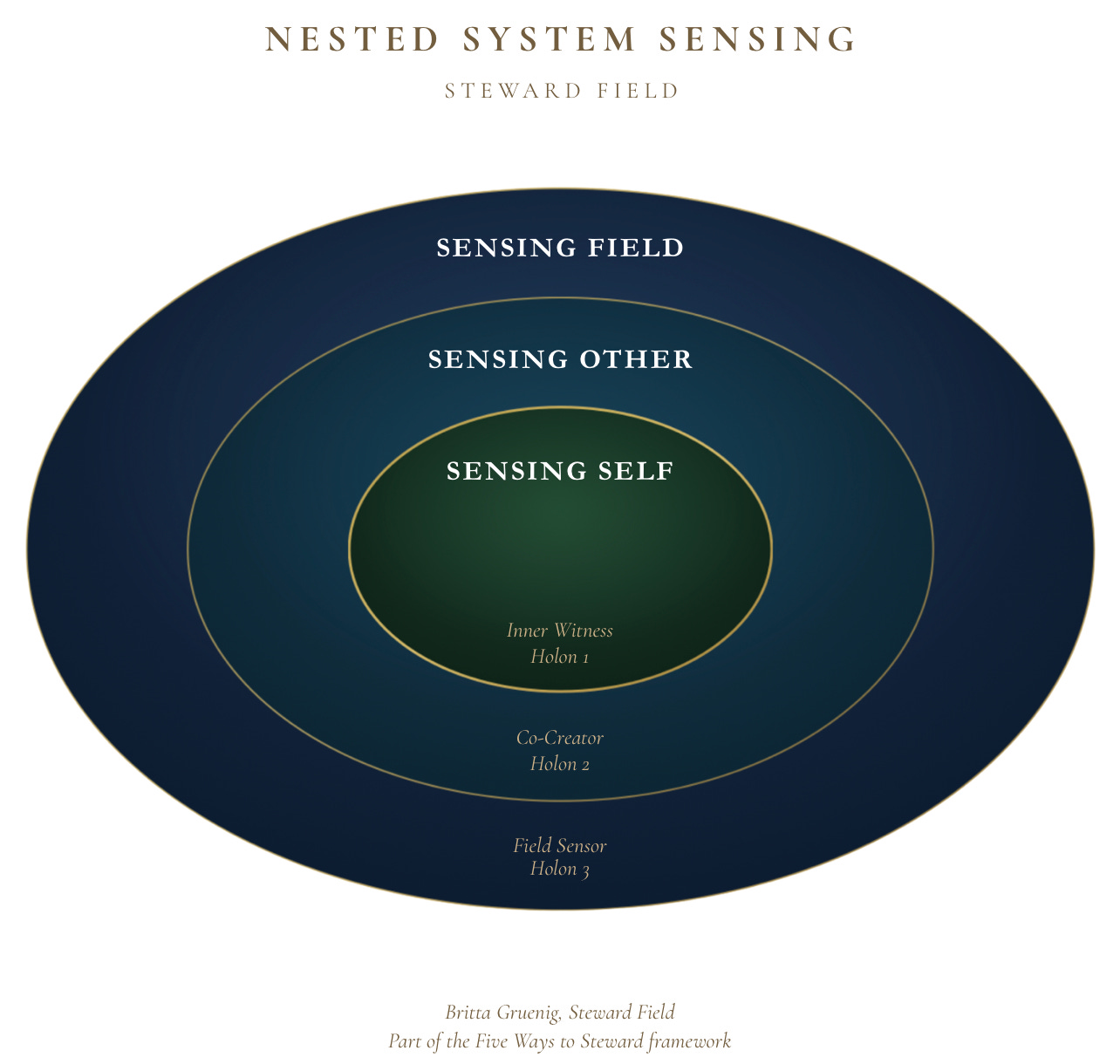
But systemic change requires a deeper practice on all levels. I call the person the Field Sensor and the practice “Nested System Sensing” - a map of the enhanced sensing capacities that wealth holders and investors need to practice as they navigate the complex, relational terrain of systemic change. It might be understood as a kind of evolved Level 3 listening applied to each holon (a whole-within-a-whole) of the nested systems at play.
Field Sensor: Before any of the other modes can function well, this one has to be alive.
I experience this most vividly when I facilitate a Social Presencing Theatre with investors and wealth holders. Participants are invited out of their minds and into their hearts and bodies - to get a glimpse of sensing themselves as part of a nested system, to feel what it is like to inhabit different roles within it, and then to sense what wants to shift. The experience is often dramatic. Nobody forgets it. Because you stop analyzing the system from the outside and start feeling it from within.
What becomes available in that state is not just better data. It is a different quality of perception - one that can sense what is stuck, what wants to move, and what is being asked of you in this particular moment.
Sensing Other doesn’t mean being able to tune out of your own thoughts and focus on what the other actually says and argues: That would be listening at Level 2 and is fundamental for a Co-Creator. But Sensing Other goes beyond. It is a practice of deep presence with the other in a way that respects the other as a system in its own right, beyond their mind and words. Sensing Other is crucial to cultivate when I work with couples, cousin groups or cross-generational families. The other is a whole with inner complexity, history, potential and partial truth just as we are. Sensing Other is a way of truly walking in the other’s shoes for a while. Living the other’s story from within for the first time - or for a little longer and deeper than usual. This can give you unexpected insights into the other’s perception of reality as it is actually experienced by them. It is a form of what I call Radical Empathy as a lever for systems change. And it doesn’t apply only to human beings in your family or in a less privileged situation than you. Sensing Other also applies to other beings and entities, whether they are an animal, a plant, an institution, or a glacier.
Sensing Field is an invitation to extend this quality of presence to the greater whole. In a room, a Field Sensor notices what is spoken and what is not. The body language, of course. But also the space between actors. The emotional field in the room. The energies that may be in dissonance and competition or confluence and synergy. What the space itself seems to be holding, or holding back. What is stuck. What hurts. What is pressing. What is opening. What wants to emerge. Beyond the room, Sensing Field means attending to the whole field, the entire context. The relationships between actors, yes, but also the impersonal and the subconscious. The system dynamics. The infrastructure that determines flows and movements. The themes of this moment in history. The ghosts of the past. The collective dreams for the future.
Sensing Self: And crucially, this sensing applies to yourself as much as to the room or systemic fields. Inner Witness can evolve to questions like: What assumptions am I carrying? What fears? What inherited patterns? Where am I sensing myself, and mistaking that for Sensing Other or Sensing Field?
The quality of sensing and listening in a collaboration shapes everything that follows.
5. Stewarding from Within: Inner Witness
The Core of the Inner Work
Wealth amplifies whatever consciousness holds it.
This is the insight I return to again and again. If wealth is held from fear, it tends to reinforce control, separation, pleasing, and protection. If it is held from coherence - from an alive sense of purpose, values, and interconnection - it can amplify care, collaboration, effective institutions, and what I have come to call Life’s regenerating impulse.
This is not a moral claim. It is a practical one. The less a steward is unconsciously driven by limiting beliefs and reactive patterns, the greater their access to an expanded relational field - to acting with integrity and authenticity, from a genuine sense of what is needed, from the grounded kind of presence that others can actually feel and trust.
In my work with wealth holders through the Regenerative Compass - the inner, relational, and outer dimensions of stewardship - I see this consistently:
The practice of the inner work is not separate from the practice of the stewardship. It is what allows the steward and the system to engage in mutual co-evolution consistently.
Inner Witness: The key that unlocks wealth and wealth holders to come alive.
In the systemic investing context, this means something concrete: Your capacity to bring others along is not just a function of the strength of your argument or the size of your portfolio. It is a function of how you show up in the room. Whether people feel met by the authentic, alive you. Whether they sense that you are actually present, actually listening, actually open - to feel and sense beyond your mind, to collaborate, to be clear about what you and your capital are in service of.
It also means having the courage to speak up when something matters - even when the room is comfortable, even when the family has always done it differently, even when the stakes feel high. Many of the stewards I work with carry a clear inner knowing about what is needed. Life has a way of speaking to us and letting us know what would truly be in service. The inner work is sometimes about getting access to that knowing but more often about getting unstuck from what keeps us from acting on it.
And beneath the courage is something else: Joy… Access to the unstoppable and invigorating Life Force that is available to all of us. Meaning. A growing sense of what you can contribute at your best, and which roles actually suit you - not the roles you inherited or performed, but the ones that draw on what is most alive in you. When a steward finds that, the work stops feeling like obligation and starts feeling like energising participation.
When the Five Ways Become a Journey
The Five Ways to Steward are not fixed categories. They are fluid ways of being - and a steward can navigate between them, sometimes in the course of a single encounter.
What follows is one journey among many. It is offered not to place one person at the centre, but because a real story - with its texture and its turns - is often what allows a framework to land.
Thomas Høgenhaven came to CSP’s Investing for Systems Change program already operating from the front: a clear conviction about what planetary investing needed to look like, and the determination to build it with his team. Then something happened in the room - not just for him, but for many of the participants.
The program included embodied exercises - Social Presencing Theatre - that took participants out of their analytical minds and into a felt sense of the system itself. Thomas wrote about it afterwards on LinkedIn: “...part of it was literally an out-of-body experience. We used our bodies to explore how systems operate. It shifted my understanding - from theoretical to actually feeling that systems can change. It’s hard to describe, but something let go inside me. It was like experiencing systems that were stuck, suddenly releasing, making room for something new.”
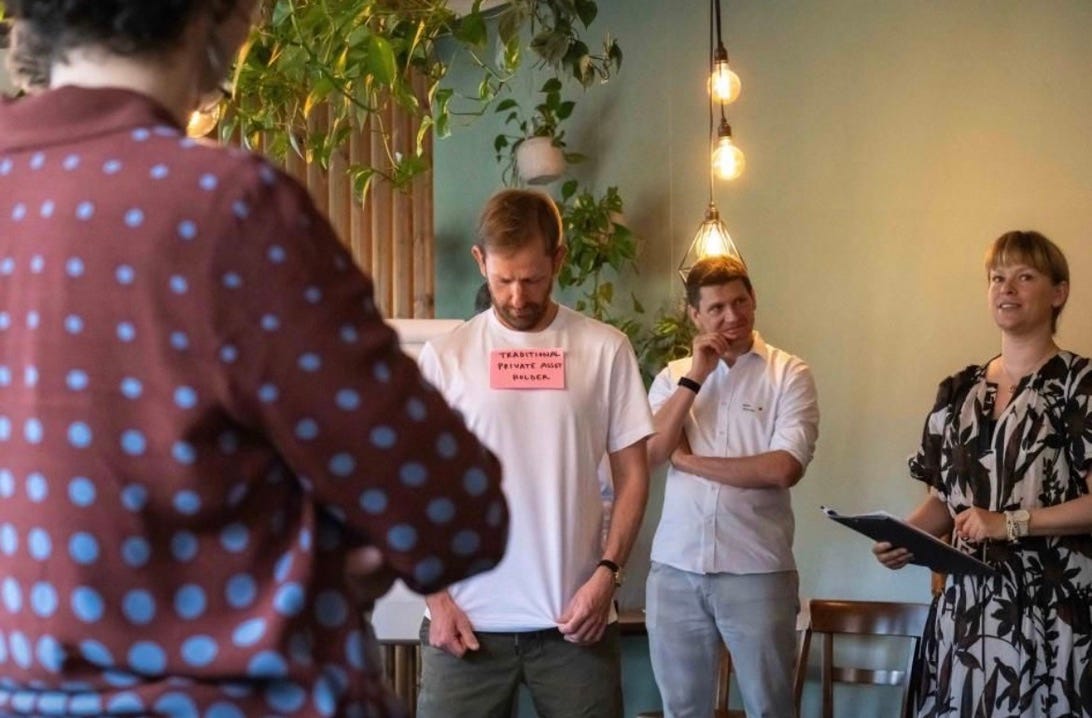
Thomas Høgenhaven embodying the role of “Traditional Private Asset Holder” during a Social Presencing Theatre at CSP’s Investing for Systems Change program - an exercise in which participants step into different parts of the financial system to sense what is stuck and what wants to move.
That is stewarding from the field - Field Sensing - in its most visceral form.
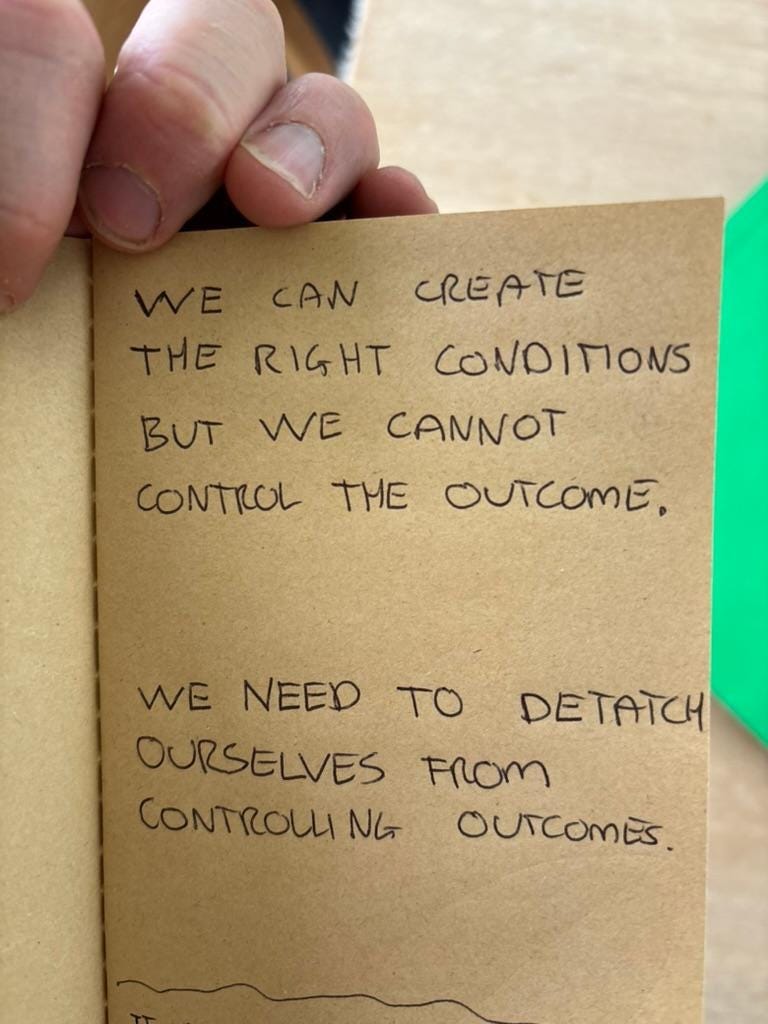
Thomas shared these handwritten notes he took during the program: “We can create the right conditions but we cannot control the outcome. We need to detach ourselves from controlling outcomes.”
And then there was one more movement. At a session, someone raised how hard it can be to let go of what you have founded and built. I made an offhand joke that I sometimes recommend a death simulation. It was a fleeting moment; I had forgotten it by the time Thomas came back and asked for one. That request, and what moved through him in that work, belongs to his own story. But the willingness to face it - to sit with the dissolution of the identity that had been driving his work - is what I would call stewarding from within. Not a strategy. Not a framework. A reckoning with who you are beneath what you have built.
What followed - for Thomas and for others who have moved through something similar - was a quieter way of being in the work. Less need to do everything oneself, to put one’s name on initiatives, or to steer from the front. A move toward stewarding from the back: supporting others, amplifying what is already alive. And alongside that, stewarding from the side: building alliances, joining forces, creating what no one could create alone.
From front, through field and within, to back and side. Not a retreat - an expansion into a fuller range of what stewardship can be.
Thomas Høgenhaven kindly agreed to his story and the pictures being shared here.
Conclusion
This arc is not unique to Thomas - and that is the point. It is, in my experience, what becomes available when an individual, a couple, a family, or a collective is willing to do the inner work of systemic investing.
The Five Ways to Steward don’t compete with each other. They liberate each other - and open up new ways of being for the stewards who move through them. A steward can hold the vision from the Front when that is what the moment asks, and disappear into the Back when that serves better. The stewards who have found their range across all five ways of being are the ones who can truly accompany a system through change.
Wealth stewardship is not simply a technical challenge. It is a developmental journey.
And it may be one of the defining journeys of our time. Not because it is about wealth. But because when stewards come alive, something shifts in how they hold wealth - and where it flows. And that shift - felt by others - is how teams form, families align, coalitions hold, and systems begin to move.
I am convinced that all of Life wants to thrive. The steward. The family. The living systems their capital touches. These are not competing desires - they are one movement. And wealth, held well, can serve all of them at once.
That capacity is cultivated from within.
A Practice: Mapping Your Stewardship
This exercise draws on the Five Ways to Steward and the Nested System Sensing. It works best done slowly, with some quiet time and a piece of paper. And once the insights emerge, you can bring them to life in all the nested systems you are part of.
Step 1: Choose a systemic investing relationship that matters to you. This might be a co-investor, a grantee, a family member, a coalition partner - someone with whom you are trying to move something forward together.
Step 2: Locate yourself. Which stewardship mode have you been operating from with this person or group? Front, side, back, field, or within? Or defaulting to Leader on Top without noticing it? Be honest. Not which one you think is right - which one you have actually been in.
Step 3: Nested System Sensing - for this relationship. Sit quietly for a few minutes and move through each practice:
Sensing Self: What are you carrying into this relationship? What do you already know, believe, or feel about it? What do you want? What are you assuming? What are your fears? What are your dreams?
Sensing Other: What is the other person or group actually bringing? What are they saying, what are they asking for? How can you have Radical Empathy and experience reality from their perspective?
Sensing Field: What is the whole of this relationship telling you? What is not being said? What is the quality of trust between you? Where is the energy stuck? What does this collaboration seem to want to become?
Step 4: Notice the gap. Is there a way of being that this relationship is asking for - that you have not yet stepped into? What would it take to try it?
You don’t need to change everything at once. You just need to stay curious about one thing: What in me might be shaping what is possible here?
That question, held honestly, is where systemic investing comes alive.
What’s Next?
This piece is part of an ongoing series on Participatory Stewardship - the philosophy at the heart of the Steward Field and the book I am currently writing: Steward Field: Where Wealth and Stewards Come Alive. If this resonates, the best way to stay close to its development is to subscribe below.
If you hold wealth or steward a family enterprise and sense this work is for you - I’d love to hear from you. And I recommend the CSP Program on Investing for Systems Change.
If you are a systemic investor, wealth holder, or practitioner navigating this terrain: I would love to hear what you are seeing. The field grows through dialogue, and your perspective belongs here in the comments.
A note on this work
This work emerged through two decades of working with wealth holders, families, and next-generation leaders at the intersection of wealth, responsibility, and systemic change - through private advisory work with families, through directing UBS Dialogue, and through field-building work with CSP Global, where I initiated, built, and continue to steward the inner-work dimension of wealth-holder education. Across these contexts, one pattern kept returning: Tensions that appeared strategic were often rooted in how people related - to themselves, to others, to systems, and to Life.
© Britta Gruenig, Steward Field. Please credit if sharing. This work is shared under a Creative Commons Attribution-NonCommercial 4.0 licence. To cite: Gruenig, B. (2026). You Are Part of the System You Want to Change. Steward Field. www.stewardfield.com
My voice over will follow... Apologies, I'm right now participating in Clownvergence - the global Clown Festival with the motto:
"If you’re here, you already sense the importance of clowning at this moment. We are living through overlapping global crises without clear maps forward, and in the midst of uncertainty, confusion, and anxiety, clowning offers something essential: the courage to face difficult truths, the relief of purposeless play, and the capacity to build real connection and community.
This year we ask: What is our responsibility - as humans, and as clowns - to one another, to Earth, to the more-than-human, and to the vast beyond? In a world on fire with hubris and collapse, yet alive with beauty and paradox, CLOWNVERGENCE reminds us that clowns hold vital skills for navigating adversity - illuminating what isn’t working, revealing the absurdity of our systems, inviting joy, and helping us laugh at our attempts to control life. Together, we reclaim both our stupidity and our brilliance as resources for an unknown future.
This gathering celebrates the beautiful diversity of clowning as it is practiced around the world, centering non-normative approaches and a wide range of subcultures. Each contributor brings something uniquely their own, and your presence is an essential part of every session. I’m deeply grateful to everyone offering their time and wisdom, and I look forward to connecting, communing, and playing together over four very special days."
Update: Now my voice over is available! 🤗