

There is a question that wealth tends to generate, sooner or later, in the people who hold it. Not a financial question - those are usually well managed. Something deeper. Something about whether what they are doing with it is right. Whether it is enough. Whether they are enough.
For some, this question arrives as pressure: I have so much. Am I doing enough with it? This pressure becomes a drive, a restlessness, a sense of responsibility that never quite lifts.
For others, it arrives as a vague unease: I have so much. And I’m not sure I’m doing anything meaningful with it at all. This unease stays in the background, surfacing at unexpected moments - at a conference, in a pause between conversations, late at night.
Both are honest. Both carry genuine care. And both, I have come to see, are expressions of the same underlying confusion - about what capital is, who it belongs to, and what it is really asking of us.
This article is about that confusion. And about what becomes possible when we find our way through it. When we recognise how deeply interconnected we already are with the living systems our capitals come from and flow towards, and when we return to ways of being and doing aligned with that truth.
Two Ways of Holding an Inheritance
I want to introduce you to two people. They are fictional - but they are drawn from two decades of work with wealth holders, families, and next-generation leaders, and from what I have observed, again and again, in myself.
Gaia was born into significant wealth, and she has always known, somewhere in her bones, that this comes with weight.
Not burden exactly - more like a calling. She feels the state of the world directly, in her body. Ecological breakdown is not an abstraction to her. Inequality is not a policy question. These things land in her as a kind of responsibility she did not choose but cannot put down.
So she shows up. She prepares. She takes on more than anyone asks of her, because someone has to, and she is good at it, and she cares. When others hesitate, Gaia steps forward. When others go home, Gaia stays.
She is admired. She is effective. She is, on most days, exhausted.
What Gaia hasn’t fully noticed yet is that the people around her have gradually stopped stepping forward. Why would they? She is already there. Her over-functioning, born of genuine love, has slowly crowded out the engagement of others - in her family, in her collaborations, in the systems she is trying to change. And in her body, something is speaking: Inflammation, disrupted sleep, the particular kind of fatigue that comes not from doing too much, but from doing everything from a place of obligation.
Gaia’s relationship to her capitals - economic, social, cultural, symbolic - is one of ownership and duty. She owns this wealth. Therefore she bears its full weight. The capital is a responsibility on her shoulders.
What Gaia has not yet allowed herself to ask is: Who said it was all mine to carry?
Felix was also born into significant wealth, and he has always known, somewhere in his bones, that this comes with freedom.
He is charming, curious, generous in his way. He moves through the world with ease - connecting, exploring, enjoying what life has to offer. He cares, genuinely and in a diffuse way, about the state of the world. He shows up to the right events, has the right conversations, finds it all rather interesting.
Felix is not indifferent. He is, in his own way, a good person navigating an ambiguous inheritance.
But there is a question he has learned to sidestep, because he doesn’t quite know how to answer it. Someone at a conference asks: So, what do you do? And Felix feels, just for a moment, something uncomfortable - a vague awareness of unlived potential. A longing he hasn’t quite found words for.
He changes the subject gracefully. He is good at that.
Felix’s relationship to his capitals is also one of ownership - but where Gaia’s ownership generates obligation, Felix’s generates something softer: A soothing buffer between him and the harder questions. No urgent reason to get out of bed in the morning for anything in particular. No burning necessity to choose. The capital insulates him, perhaps more than he realises, from the living systems it came from and the questions those systems might ask of him.
What Felix has not yet allowed himself to feel is that the questions he carries are not a threat. They are an invitation into purpose.
The Same Logic, Blocking the Same Spark
Gaia is giving everything she has. Felix is holding everything he has. From the outside, they seem to be living entirely different lives.
But when we look at the logic underneath, we see they share a root.
Both are operating from an ownership logic: I own these capitals - economic, social, cultural, symbolic - and therefore I determine what they mean and what I do with them. For Gaia, ownership generates the weight of full responsibility. For Felix, it generates the soothing buffer of no particular responsibility. Same underlying relationship to capital, different ways of living it out.
And both, in their own way, are cut off from something essential.
Gaia is giving so much that she has stopped receiving. She is depleted not just by the work, but by the way she holds it - alone, at the centre, as if the whole world depends on her.
Felix is receiving freely, but not yet in conscious relationship with what he is receiving from, or what it might ask of him in return. Beneath the ease, there is a hidden ache: The particular loneliness of living at a comfortable distance from your own potential and the rest of society.
Neither is whole. And neither, if we are honest, is truly serving the living systems they care about. For both of them, those living systems remain out there - something to be impacted or enjoyed, rather than something they are already inside of, already in relationship with, already part of. Indigenous Knowledge Systems lived in this original knowing. When I write ‘Life’ with a capital L, I mean something larger than individual lives or biological processes - the living, relational whole that we are part of and that is always, in some sense, speaking to us.
The ownership logic blocks the regenerative spark that is inherent in living systems. Not through bad intentions - both Gaia and Felix have genuinely good ones. But by keeping Life at arm’s length: As something to be managed, protected, or experienced, rather than something all of us belong to.
The Shift: Participatory Stewardship
For a long time, I poured everything into others. Every room I entered, I used to maximize the transformative potential of everyone in it. I saw myself as a vessel for the evolution of life and consciousness. My own experience, my own creativity, my own transformation and growth - these were always in service of others. Other people’s growth was the point. And the results showed it: The rooms came alive, people shifted, their capitals moved something real in the world.
Which is exactly what made it so hard to question.
At a retreat, I was asked to do something I rarely do: Instead of facilitating, instead of holding the space for others’ transformation, I was asked to tell a personal story from my own life that illustrated my own growth. I felt it immediately - the resistance, the discomfort, the sense that this was a waste of everyone’s time. Why would anyone want to listen to my story, when I could be helping them?
In the coffee break, I went to talk to my friend about it - Indy Johar, one of the most profound systems thinkers I know. And he said something simple: It’s not balanced if you just do one thing and never do the other. He didn’t say much more. It landed like a key turning in a lock.
And the next weekend, everything clicked into place. Having worked with regenerative principles, I kept asking myself what I need to keep flourishing. I realised, thanks to conversations with my friends, that at that moment in time, what was needed was to tend and share my own fire. And since Jane Goodall had just died between those two weekends, I understood something I had never quite let myself apply to myself: Jane Goodall spoke from the heart, in public, about her story and what truly matters. She gave her fire a talking stick. This was what I needed to do as well.
This Substack is my talking stick.
Along the way, I acquired an ukulele. I named her Leela - the Sanskrit word for divine play. I am not good at it. I don’t perform it for anyone. It is purely, delightfully purposeless. That too, I have come to understand, is part of what it means to be a participant in life.
I am settling into a new sense of balance - held, I feel, by something larger than my own effort. I no longer want to identify purely as a vessel for good. I am both a steward in service of Life and a participant in Life. The work of evoking transformation in others is still very much part of who I am as a Stewardship Advisor. But it is now balanced by sharing my own authentic voice - as one of many participants in our living systems. And it is balanced by making sure that play, like Leela, has a regular place in my life.
It was in living this question that I found the clarity to name what I now call Participatory Stewardship.
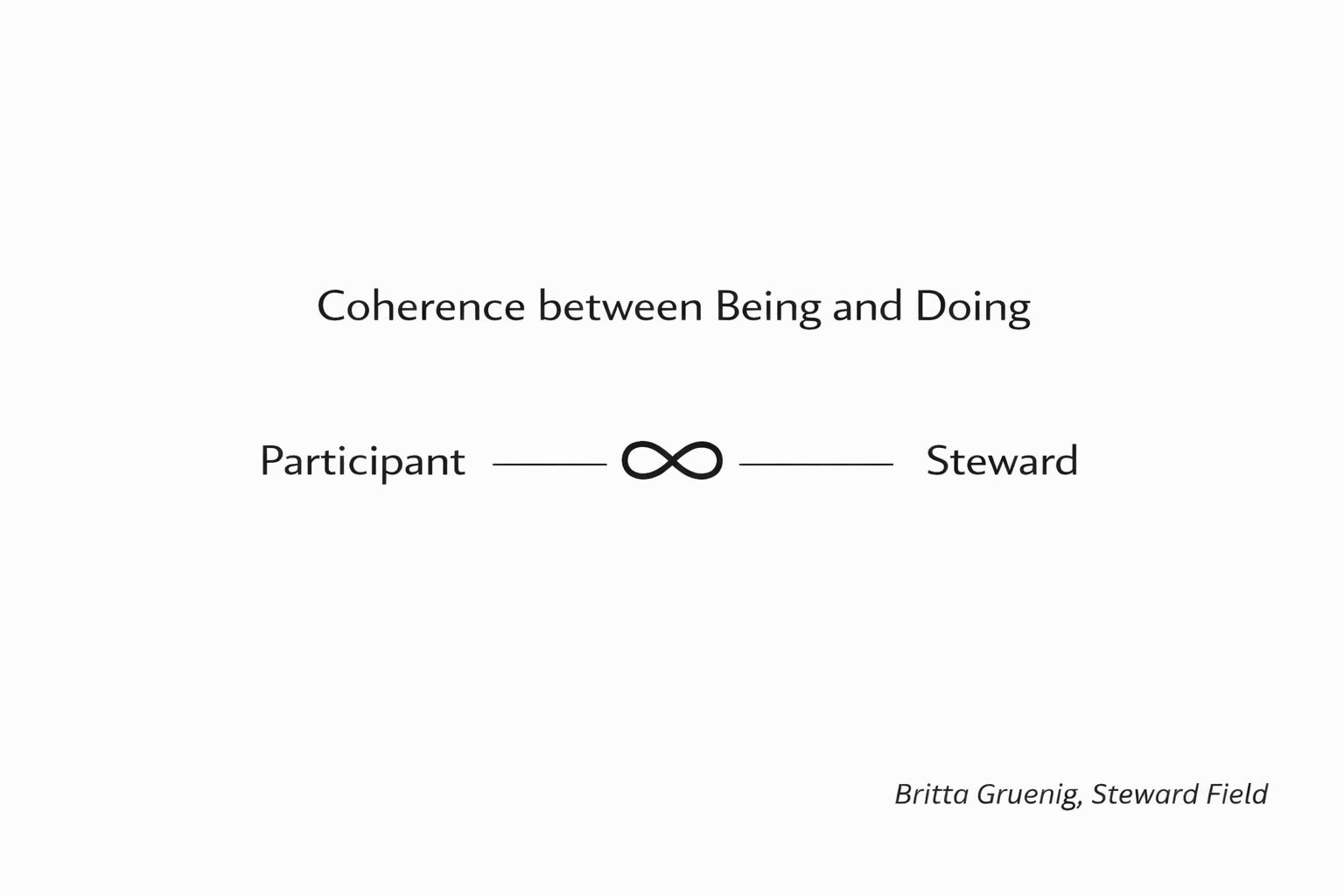
Participatory Stewardship is not a midpoint between Gaia and Felix - a compromise between doing too much and doing too little. It is a genuinely different relationship to Life, in which being and doing are not in tension with each other, but in a continuous flow. Like the two loops of an infinity symbol, each one becoming the other.
We are all participants in Life - this tree, this lake, this family, this ecosystem. All of us want to thrive. And as participants, we get to grow like a seedling grows thanks to soil, light, water and more in its context: Life’s affirming current works for us, nourishes us, moves through us, loves us. As stewards, we make other things grow like the caring hand that plants the seedling - we become a channel through which that same current flows outward and nourishes other beings.
We don’t need to be torn between being and doing. We can unfold into the coherence of both, giving and receiving as one continuous circular flow in the larger whole.
As participant in Life, I am nourished. As steward in service of Life, I nurture. Life flows through me as I receive it. And Life flows through me as I offer it back.
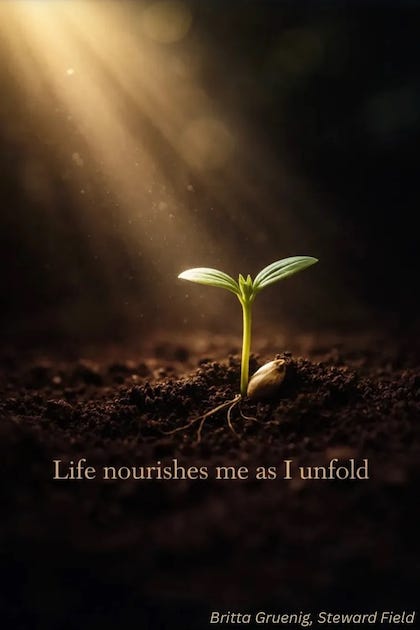
Life nourishes me as I unfold.
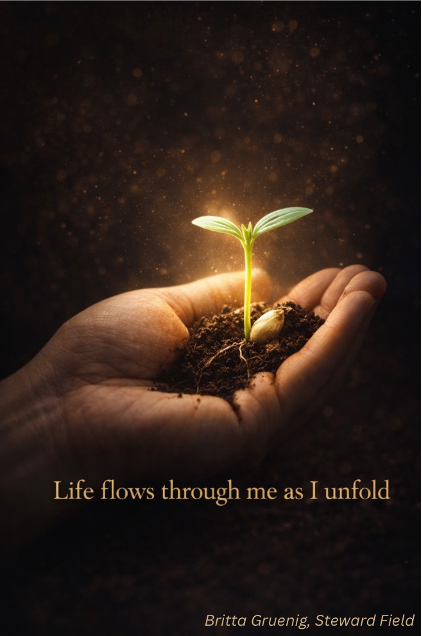
Life flows through me as I unfold.
Both images are true at once. Neither requires ownership. Both require presence. And both are available to Gaia and Felix equally - not as opposite prescriptions, but as two qualities of the same living wholeness each of them is already part of.
The shift is not a personality change or a new strategy. It is a change in the fundamental relationship to capital - and to Life itself.
From: I own this, therefore I decide. To: I am entrusted with this, within a living web I am already part of - and that nourishes me.
This is not a destination either of them reaches once and rests in. It is, in my own experience, a spiral - you find your way into this quality of being, and then something happens and the old pattern returns. The practice is not to arrive somewhere permanently, but to keep noticing, keep choosing, keep unfolding.
What Participatory Stewardship Means for Our Capitals
Participatory Stewardship changes not just our psychology - it changes our relationship to wealth itself.
When economic, social, cultural, or symbolic capital is held as something we own, it becomes either a burden or an insulation. Either way, it places us apart from the living systems it has moved through - the people, ecosystems, communities, and generations it came from and flows toward.
But what if we understand wealth differently - not as stored, extracted value that we own and deploy, but as something more like a regenerative lifeblood that is intended to nourish Life? A circulating capacity that has always moved through living systems, and that we are, for a time, entrusted to steward?
This reframe does something. It dissolves the fiction of the isolated owner and reveals what was always true: That we are already entangled, already in relationship, already inside the systems we thought we were observing from outside.
For Gaia, this is a liberation. She doesn’t have to carry it all and do it all. The web of life holds far more than she does, and it was never hers alone to nurture. She can allow herself to balance effective collaborative stewardship with slowing down, breathing, and being delighted by life. Like any other beautifully ordinary life form that participates in Life.
For Felix, it is the invitation to purpose. The questions he has been sidestepping are not a demand or an unjust imposition - it is the web of life calling him home into meaningful participation. He can live up to his innate potential and grow by engaging with a clear commitment of his capitals and reciprocity in the wider systems he is already part of. And there is something else: The illusion of separation slowly dissolves. The loneliness of living at a comfortable distance from life - from its demands, its textures, its mutual co-evolution - begins to lift.
And for both, a different set of questions becomes possible. Not just “what should I do with my capital?” but:
“From which living systems did this wealth come, to nourish us? To which living systems does this wealth currently flow, to nourish them?”
A Practice: Coming Home to the Flow
This practice has two parts. It works best with a journal, some quiet, and a willingness to be honest.
Part 1: Is Gaia or Felix alive in you right now?
Read the portraits of Gaia and Felix again. Notice where you feel recognition - not where you think you should recognise yourself, but where something actually stirs. Most of us carry both, in different proportions and different seasons.
Then sit with these questions:
What are the genuine good intentions behind the ways I am showing up?
What is it costing me - in my own health, my emotions, my relationships, my sense of aliveness?
What might it be costing the people, living beings and systems around me?
If I relate to Gaia: What triggers me in how Felix operates? If I relate to Felix: What triggers me in how Gaia operates?
Part 2: Wealth as relationship
Find a moment away from screens, ideally somewhere you feel grounded.
Bring to mind a specific form of capital you hold: Economic wealth, social influence, cultural knowledge, symbolic standing. Hold it in your awareness not as something you own, but as something that has moved through many people, many soils, many systems before you were able to hold it.
Then ask with presence:
From which living systems did this wealth come, to nourish us?
Let the question crack something open. Follow the threads backwards - through generations, through geographies, through the ecosystems and communities whose contribution made this possible.
Then ask:
To which living systems does this wealth currently flow, to nourish them?
Follow the threads forward. Not with judgment, but with curiosity.
What do you notice? What wants to shift?
So - what is enough?
Perhaps the question itself shifts when we stop holding capital as owners and start inhabiting it as participants and stewards. Enough is not only a quantity. It is a quality of relationship. When we stop owning our capitals and start belonging to the living web they come from - something settles. Not because the work is done. But because we are finally doing it in the right context.
What’s next?
This piece is part of an ongoing series on Participatory Stewardship - the philosophy at the heart of the Steward Field and the book I am currently writing: Steward Field: Where Wealth and Stewards Come Alive. If this resonates, the best way to stay close to its development is to subscribe below.
If you recognise yourself in Gaia or Felix - or in both - I would love to hear what stirs. The field grows through dialogue, and your experience belongs here.
A note on this work
This work emerged through two decades of working with wealth holders, families, and next-generation leaders at the intersection of wealth, responsibility, and systemic change - through private advisory work with families, through directing UBS Dialogue, and through field-building work with CSP Global, where I initiated, built, and continue to steward the inner-work dimension of wealth-holder education. Across these contexts, one pattern kept returning: Tensions that appeared strategic were often rooted in how people related - to themselves, to others, to systems, and to Life.
© Britta Gruenig, Steward Field. Please credit if sharing. This work is shared under a Creative Commons Attribution-NonCommercial 4.0 licence. To cite: Gruenig, B. (2026). What Is Enough? Steward Field. www.stewardfield.com
Hi Britta, I've been circling these kinds of questions for a while now using ChatGPT to help connect multiple perspectives along with my own. I'm reluctant to share much of it as if feels like the AI is doing the heavy lifting, but I'll let you decide for yourself. I'm struggling with taking a concept into something tangible... https://chatgpt.com/share/697e4a3c-9654-8009-8da3-dc9d6a64ce32
I really enjoyed this, Britta. The Gaia archetype felt very familiar to me. I spent more than 15 years in retail category management, putting all my energy into growing other businesses, improving their categories, and making the customer experience better. I was good at it. Still, at some point, I realized I was always building things for others and never focusing on myself. It took me a while to shift from asking, "What am I doing for them?" to "What is this doing to me?" Do you often see people who are so focused on helping others grow that they forget about their own growth?