

Impact investing and philanthropy have underdelivered. Not because the vision was wrong. Not because the capital was insufficient. Because the inner driver was never addressed — and that driver is fear. Systemic investing now stands at the same threshold. The question is whether the field is willing to look at what prior generations of impact work could not bring itself to see.
Research from adult development and leadership effectiveness is unambiguous: 80% of adults never move beyond fear-based patterns. Why would wealth holders be different?
In this piece, I introduce the Steward Circle — a map of how Fear contracts capital and how Love stewards it. I name the three fear-based patterns shaping how impact capital moves, trace their systemic cost for stewards and living systems, and show through three real stewards what unlocks when the inner driver changes. A Stewardship Archetype Quiz at the end invites you to locate your own pattern.
Three People You May Recognise
Gaia carries wealth as a calling. She shows up, over-gives, over-functions — born of genuine care and a fear she hasn’t quite named yet: that if she stops, she will be seen as just another privileged person who looked away. Her enough is never enough. There is always more responsibility to absorb, more to carry, more to give. (I introduced Gaia more fully in What Is Enough? — her full portrait is there.)
What Is Enough?

There is a question that wealth tends to generate, sooner or later, in the people who hold it. Not a financial question - those are usually well managed. Something deeper. Something about whether what they are doing with it is right. Whether it is enough. Whether
Felix carries wealth as freedom. He moves through the world with ease, shows up to the right conversations, finds it all rather interesting — and has learned to sidestep the question he doesn’t quite know how to answer. Underneath the ease, a quiet fear: that if he engages fully, the questions will expose something he cannot yet meet. His enough is perpetually deferred. No urgent reason to choose. (Felix also appears in What Is Enough?)
Magnus was also born into significant wealth, and he has always known, somewhere in his bones, that this comes with a benchmark.
He watched his grandfather build something from very little. He watched his father protect and grow it. And he understood, young, that this is what you do. You perform. You deliver. You do not let things slip.
So he shows up — not from obligation like Gaia, not with ease like Felix, but with a determination to succeed. He has a view on every investment. A position on every allocation. He has read the reports, stress-tested the assumptions, and arrived at the meeting having already formed his conclusions. When others are still finding their footing, Magnus has already decided.
He is sharp. He is rigorous. He is, by most measures, exactly what a wealth holder is supposed to be.
Magnus is also generous — genuinely, not performatively. He gives to causes he believes in, and he gives seriously. But he chooses where every euro goes. He would not understand — could not quite understand — why someone would hand capital to others and simply trust them to know best. To release control of the allocation would feel less like generosity and more like abdication.
What Magnus hasn’t fully noticed yet is what this costs the people around him. How his siblings have stopped proposing ideas they know he’ll question. How the conversations that might have opened something new — about what the wealth is actually for, about what enough might mean — never quite get started, because Magnus has already arrived at the answer before the question has been fully asked.
And in quieter moments — though he does not linger in them — there is a faint unease when capital is spent rather than grown. A discomfort that has nothing to do with actually needing the money, and everything to do with what the number represents: proof. Every withdrawal is, in some small way, a reduction of the score.
What Magnus has not yet allowed himself to ask is: What if the wealth knows something I don’t? What if the living systems it flows toward have something to teach me, if I could stop directing long enough to listen?
Which of these do you recognise — in yourself, or in someone close to you?
The Tools That Hold Us
We live in an era of overlapping crises — ecological, political, social, economic. Polycrisis is the word that has emerged to name what it feels like when multiple systems strain simultaneously. And one of the things polycrisis does, reliably, is make people contract.
In times of greatest uncertainty, we reach for the tools that kept us safe before. This is not weakness. It is adaptation. Most of us chose our tools in childhood or early adulthood, when they were exactly what we needed. We became so good at using them that putting them down no longer feels like an option.
We think the tools serve us. But in the moments that most demand our expansion — when the world is asking for our best — the tools tighten their grip. We are no longer holding them. They are holding us.
The Tray — The Pleaser
A tray is made to carry things for others. It is versatile and can serve various functions. First it brings food, then it clears the plates. Both hands of the carrier are occupied. There is no hand or time left to nourish yourself. The pleasing never ends.
The Binoculars — The Protector
Binoculars bring the distant world into sharp focus — from a safe, remote place. The one holding them sees and judges everything clearly. In hyperfocus, there is no reason to put them down. You stay hidden. The protecting never ends.
The Steering Wheel — The Controller
A ship’s steering wheel is the single point from which the whole vessel is directed. Someone has to hold it — firmly, constantly, without letting go. Both hands on the wheel, there is no space for a second captain. The controlling never ends.
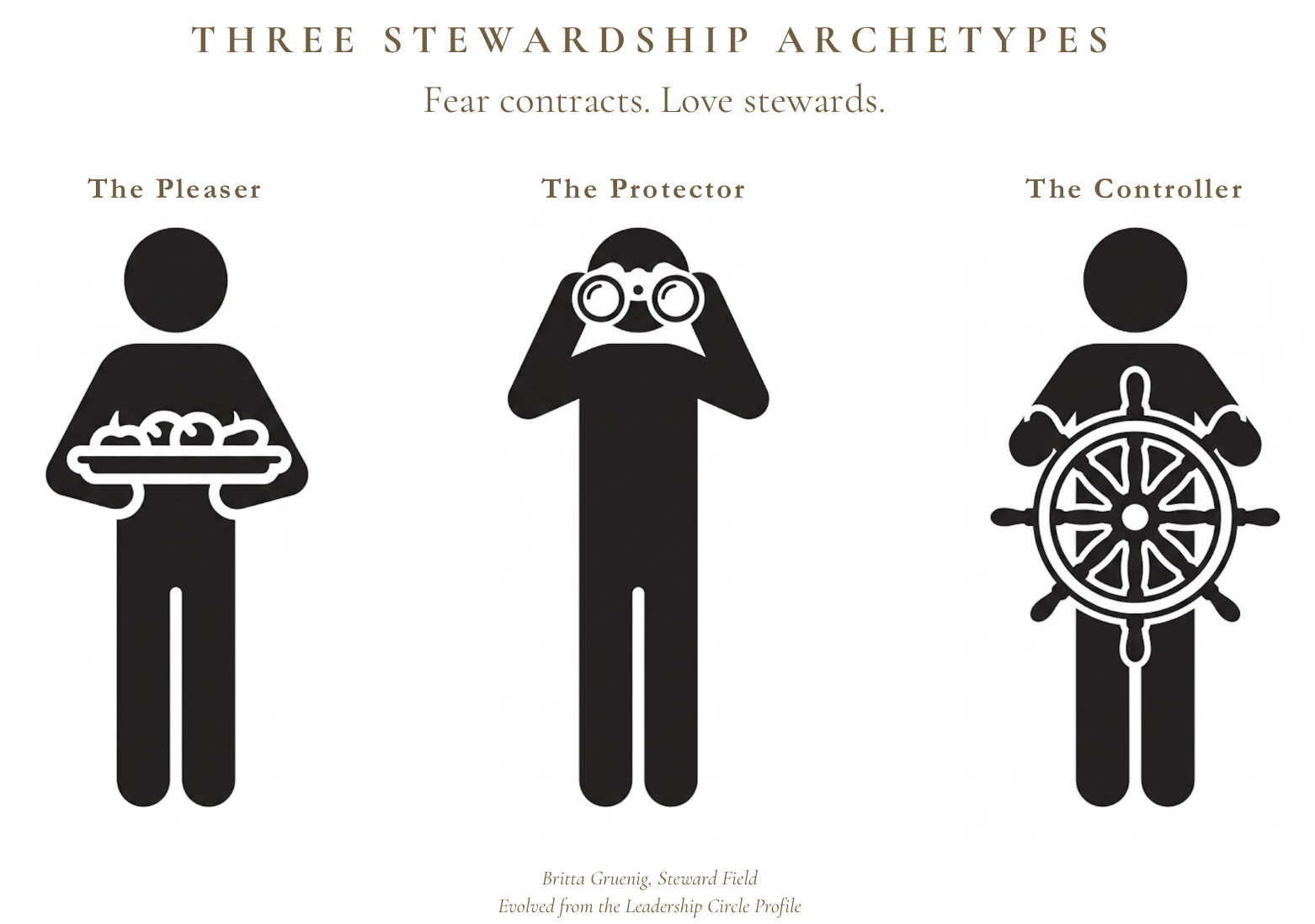
[VISUAL: The three archetype icons — The Pleaser with the Tray, The Protector with Binoculars, The Controller with the Steering Wheel]
The Fear Behind the Capital
Gaia gives until it hurts, because stopping feels like betrayal. Felix holds back, because engaging feels like exposure. Magnus controls every allocation, because releasing feels like failure. Three completely different behaviours. One shared mechanism:
Fear deciding what “enough” looks like.
Not bad strategy. Not wrong values. Fear — specific, personal, largely unexamined — quietly determining how capital moves, how much feels safe to deploy, who gets to be trusted with it, and what counts as enough.
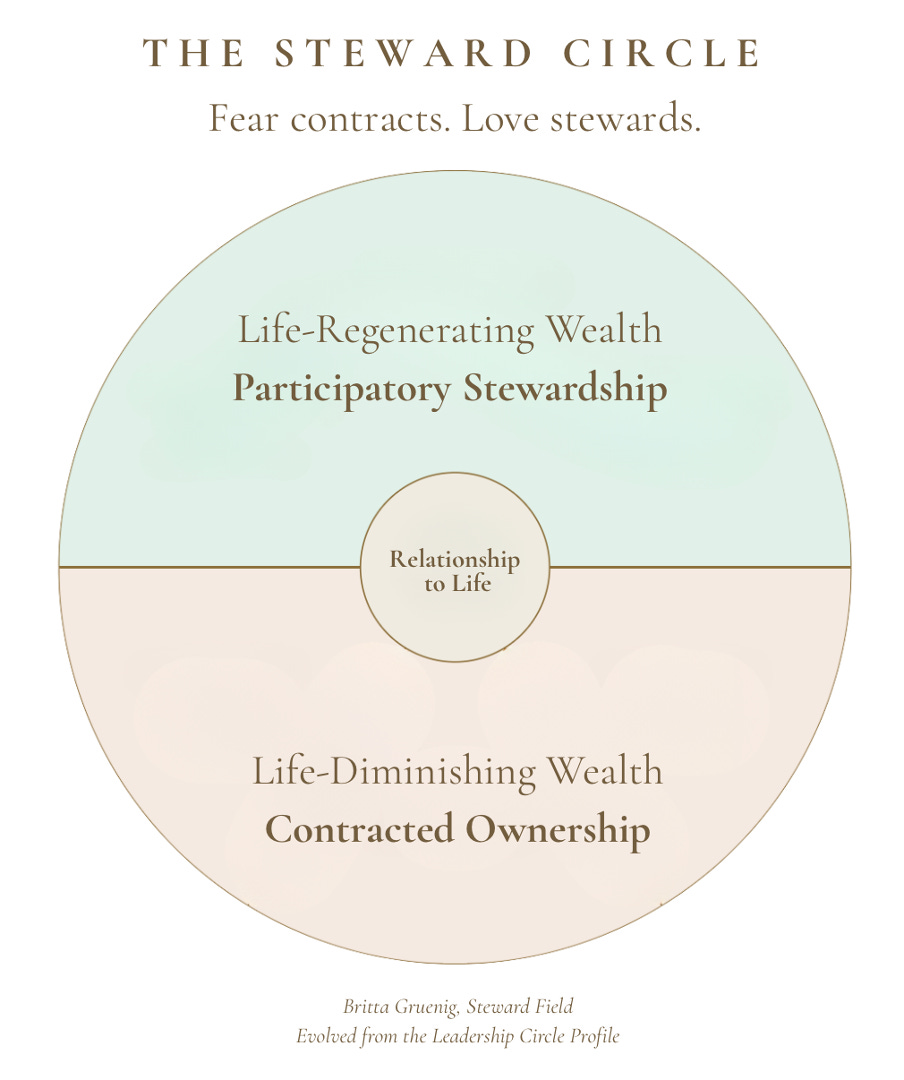
[VISUAL: The Steward Circle — a circle divided by a horizontal line. Above: Life-Regenerating Wealth, Participatory Stewardship. Below: Life-Diminishing Wealth, Contracted Ownership. At the centre: Relationship to Life]
Most of us operate from the lower half of this circle — Contracted Ownership. The relationship to capital is one of ownership: I own this, therefore I protect it, direct it, or carry its weight. What lies above the line is Participatory Stewardship: a fundamentally different relationship to wealth, to Life, and to the living systems our capital has always been part of. The threshold between the two is not a strategy. It is an inner shift. And the thing that most reliably keeps us below the line is the fear we have not yet named.
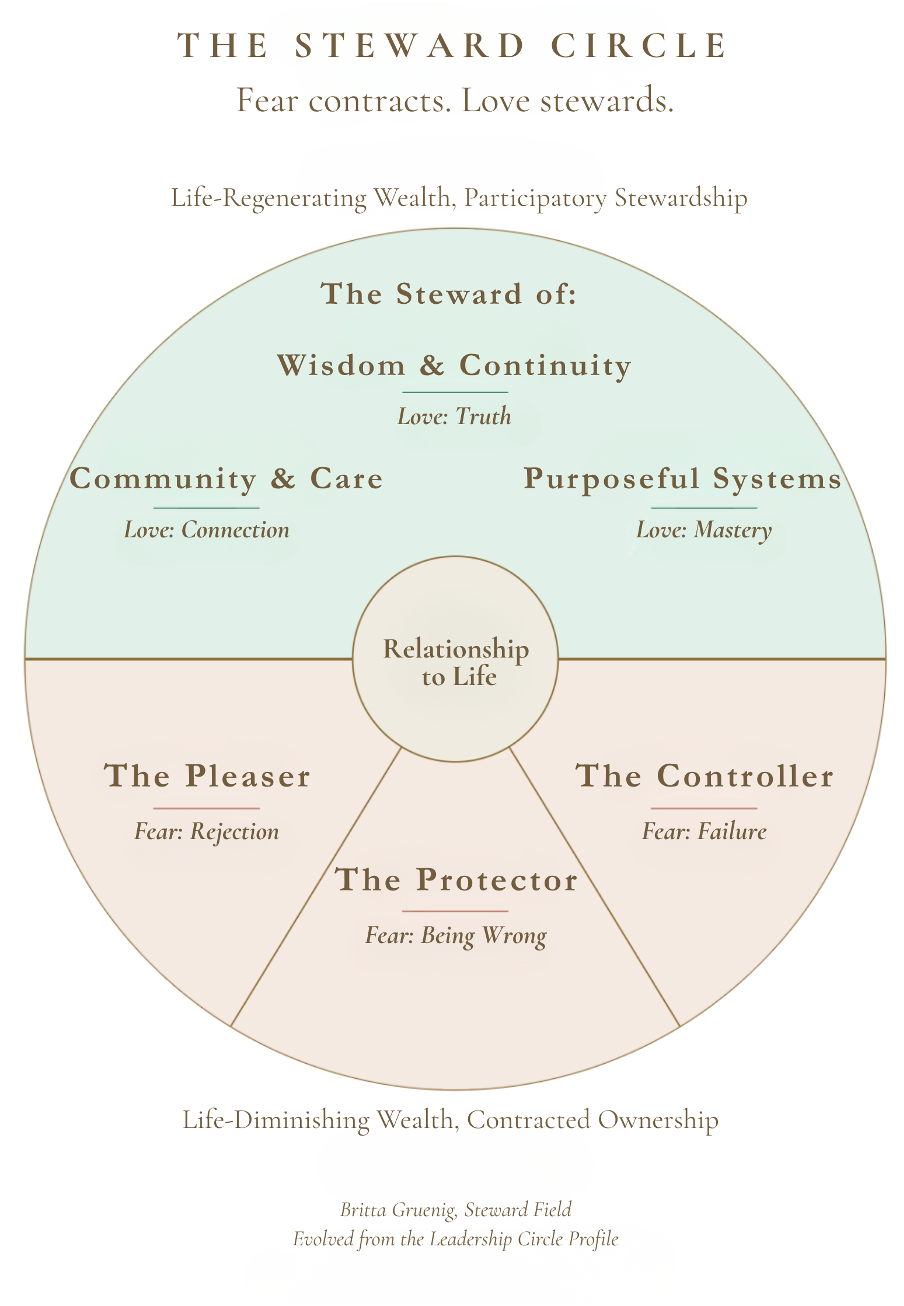
[VISUAL: The Steward Circle — full version, showing below the line: The Pleaser (Fear: Rejection), The Protector (Fear: Being Wrong), The Controller (Fear: Failure). Above the line: Stewardship of community and care (Love: Connection), Stewardship of wisdom and continuity (Love: Truth), Stewardship of purposeful systems (Love: Mastery). At the centre: Relationship to Life.]
These are not personal failings. They are adaptive responses — patterns that made sense once, in a family, in a culture, in a formative moment. The Leadership Circle’s decades of research on reactive leadership confirms this: the patterns that limit us were once the patterns that protected us.
The Pleaser learned that love was conditional on contribution.
The Protector learned that vulnerability was dangerous.
The Controller learned that security had to be built and defended.
The fear was a solution to a real problem. The problem, in most cases, has changed. The pattern remains.
Each pattern genuinely loves something real. The Pleaser loves connection. The Protector loves truth. The Controller loves mastery. These are not small things. But when fear takes the steering wheel, the love gets distorted — and capital moves in the direction of the fear, not in the direction of what is actually needed.
The Systemic Cost
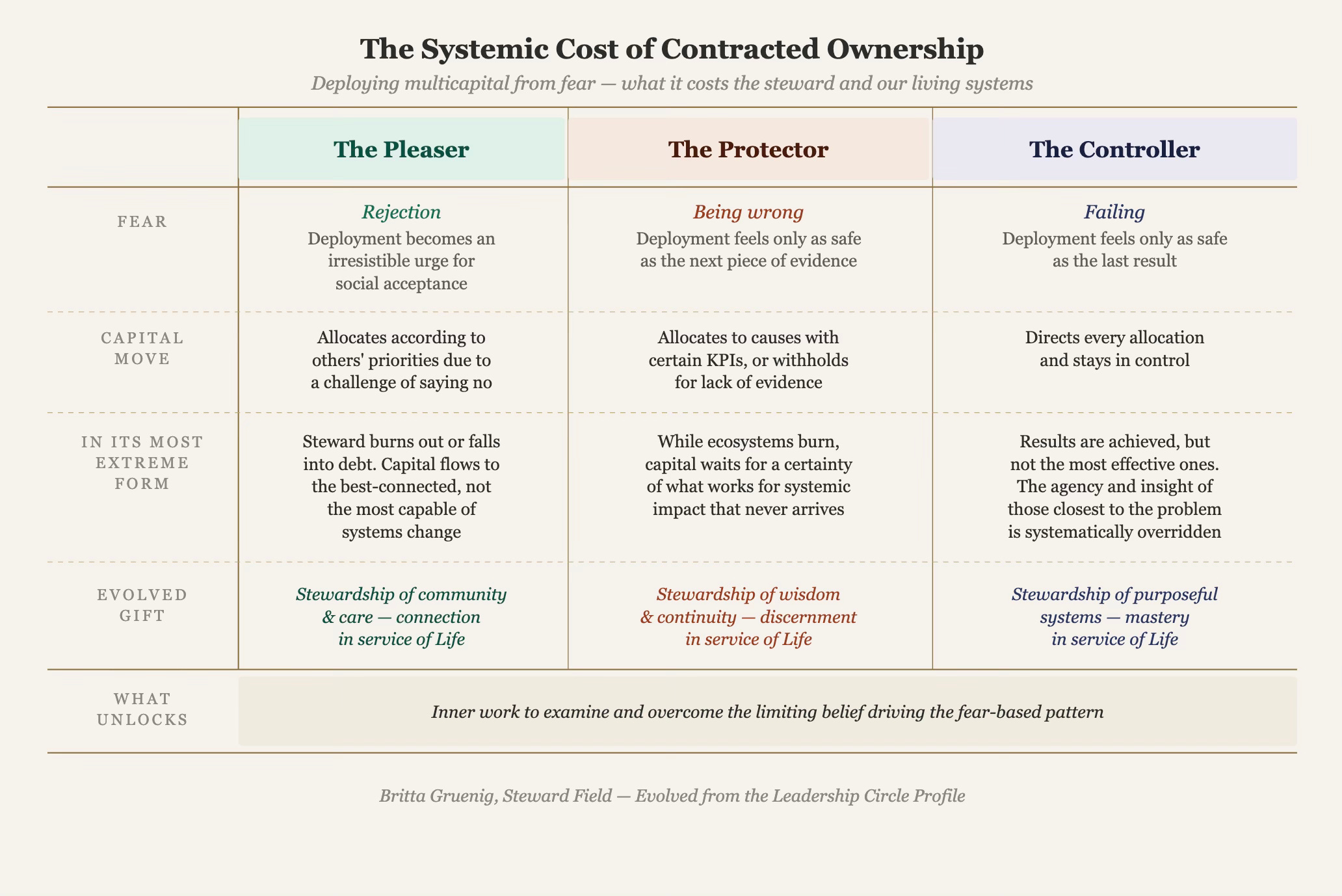
[VISUAL: The Systemic Cost of Contracted Ownership — a table showing, for each archetype: the fear, the capital move it produces, what this looks like in its most extreme form, the evolved gift available, and what unlocks for all three through inner work.]
This is not only a personal struggle. It is a structural inefficiency — one that compounds across families, foundations, and portfolios. And it is almost entirely invisible in the conversations the impact field is currently having.
What becomes possible
Three people show what happens when the Love is freed from the Fear.
Fred Tsao is the fourth-generation steward of TPC (Tsao Pao Chee), a family enterprise founded in Singapore in the late 1800s. He has redirected USD 320 million toward impact and well-being sectors, oriented his activity around what he calls “Love as infrastructure” — the idea that care, when it stops being personal and becomes structural, can redesign how economic systems are built — and initiated cross-continental partnerships through IMPACT Week, his annual convening platform in Singapore. People and systems grow together, or not at all. This is what becomes possible when the wonderful gift of connection is freed from the fear of rejection: community and care not as obligation, but as architecture.
Prince Albert II of Monaco has spent two decades turning a love of truth into a multigenerational commitment. His Foundation co-financed the Ice Memory Sanctuary — inaugurated at Concordia Station in Antarctica in January 2026, preserving ice cores from threatened glaciers at -52°C for scientists not yet born. He co-founded the ReOcean Fund, which has raised $73 million to invest in companies delivering measurable ocean health benefits — investors, not donors. As he put it: “Time is running out if we want our next generations and the generations after that to continue living on this beautiful planet.” That sentence contains no fear of being wrong. It contains only this deep gift: the long view, held clearly, acted on.
Mackenzie Scott gave $7.2 billion in 2025 alone — to roughly 225 organisations, unrestricted, often as a surprise, without requiring recipients to report back to her. According to Forbes, she gave more in 2025 than Musk, Page, Ellison and her former husband Bezos have given in their lifetimes combined. She gives without strings, without directing outcomes, without needing credit. Her own words describe the logic: “There is nothing new about amplifying gifts by yielding control. Generosity is generative. Sharing makes more.” This is mastery freed from the fear of failing — not the mastery of directing, but the mastery of knowing when to let go. Purposeful systems, trusted to find their own intelligence.
None of them abandoned what they love. They freed their gift from what they fear.
Why it matters
The impact field has spent two decades ignoring the core question.
The core question is: What fear is holding back the flow of capital towards life sustaining systems? This felt too soft for most people working on impact. Or perhaps it did not feel soft at all. Perhaps it felt too scary to look at. Because remember: 80% of adults never do the inner work to overcome their fear-based patterns.
The result of ignoring the core question was decades of progress on the technical front — better measurement, smarter vehicles, more coordination, larger commitments. All of it well-intentioned. None of it addressing the thing that actually determines where capital flows and how it moves once it arrives.
Fear does not announce itself. It arrives dressed as prudence, as rigour, as responsibility, as care. That is what makes it so difficult to see — and so expensive when left unseen.
A Pleaser like Gaia who cannot say No does not experience herself as fear-driven. She experiences herself as responsive, as relational, as doing the right thing.
A Controller like Magnus who overrides collective intelligence does not experience himself as fearful. He experiences himself as having an action bias.
A Protector like Felix who keeps capital in reserve does not experience himself as avoidant. He experiences himself as the last line of defence against a naive decision.
The pattern feels like a strength precisely because, once, it was one.
This is why naming the fear is not a fuzzy exercise. It is precise acupuncture.
When fear loosens its grip on how capital moves, something shifts that no measurement framework can engineer.
The Pleaser begins to fund what is needed rather than what maintains the relationship.
The Protector releases capital before conditions are perfect, trusting that imperfect deployment in service of systemic need outperforms perfect withholding.
The Controller discovers that ceding control to those closest to the problem does not reduce impact — it multiplies it.
These are not small adjustments. They are a different theory of change. One in which the inner life of the steward is not incidental to the impact of the capital, but constitutive of it.
Wealth held from Fear moves toward protection.
Wealth held from Love moves toward Life.
This is what Fred Tsao, Prince Albert and Mackenzie Scott have in common — not their sectors, not their geographies, not their giving vehicles. They have each done the inner work of loosening the grip. And that loosening changed not just how much they give, but what their giving is capable of doing.
The question for the field is not only: Where should capital go?
It is: From what inner place is it currently moving — and what becomes possible when that changes?
Practice: Take the Stewardship Archetype Quiz
Which archetype is most alive in you? Take the Stewardship Archetype Quiz — your full archetype portrait will arrive in your inbox.
Quiz link: Stewardship Archetype Quiz
Reflect on how you have personally approached impact and the question “What is Enough?” until now.
Which fear decided “what is enough” for you?
Which of the three Stewardship Archetypes introduced here has been unconsciously deciding what is enough for you?
In other words: which tool has its grip on you — the Tray, the Binoculars, or the Steering Wheel?
This is an honest inquiry. The fear was once a reasonable response to something real. The tool may have served you well. It may have built something worth building.
But is the fear still the right guide for what comes next?
And if it softened — just a little, not all at once — what might become possible with the capital you hold?
So — why will systemic investing underdeliver unless something changes?
For the same reason impact investing and philanthropy did. Not because the vision is wrong. Not because the capital is insufficient. Because fear is deciding. And fear, however well-dressed, cannot build what love is asking for.
When the fear loosens — even a little, not all at once — something shifts. Not in the strategy. In the steward. And that shift, quiet as it is, changes where capital flows, who it trusts, and what it becomes capable of. That is the leverage point the field has been missing.
Fear cannot build what Love is asking for. That is the subject of the next piece.
What’s next?
This piece is part of an ongoing series on Participatory Stewardship - the philosophy at the heart of the Steward Field and the book I am currently writing: Steward Field: Where Wealth and Stewards Come Alive. If this resonates, the best way to stay close to its development is to subscribe below.
If you hold wealth or steward a family enterprise and sense this work is for you - I’d love to hear from you.
If you recognise yourself in Gaia, Felix or Magnus — or in more than one — I would love to hear what is coming up. The field grows through dialogue, and your perspective belongs here in the comments.
A note on this work
This work emerged through two decades of working with wealth holders, families, and next-generation leaders at the intersection of wealth, responsibility, and systemic change. The Steward Circle and its three archetypal patterns build on The Leadership Circle’s decades of research on reactive and creative leadership. What I add is the relational dimension: these are not just leadership patterns but ways of relating to Life, family, and wealth.
© Britta Gruenig, Steward Field. Please credit if sharing. This work is shared under a Creative Commons Attribution-NonCommercial 4.0 licence. To cite: Gruenig, B. (2026). The Fear Behind the Capital. Steward Field. www.stewardfield.com
I find this article really interesting. I resonate with the opening statement of looking beyond impact investing and philanthropy, and now even systemic investing. Perhaps its about getting so caught up in labels to identify with that take us away from the real 'work', that is the inner work. I resonate with Magnus right now: looking for evidence in potential partnerships and bearing the responsibility to protect and not be 'flippant' is the word that comes to mind with decisions.